An adventure in feng shui
About twenty-five years ago I decided that it was time for me to investigate feng shui.
That was the sort of thing I did throughout the 90s. I heard about some paranormal or fringe topic and I decided to investigate it, no matter how weird or silly. I’d balance skepticism with an open mind. It had proven productive on many occasions. And this habit is also what led me to astrology around the same time period.
I have to admit that I was wary; it seemed painfully privileged. Only the very poor or the very rich seem to have a lot of living space and have no concerns about clutter. If you’re poor, you don’t have anything to fill your dwelling. If you’re rich, you have a lot of extra space or can afford to throw things away and replace them when you’re bored.
Still, the idea that a space has a flow of energy like chi flows through meridians in the body seemed plausible to me, and that it could be disrupted and mended also reasonable. So, I was up for an experiment.
I bought a used paperback on “Chinese Geomancy” for about dollar, and studied it. I can’t remember the author or the title; but it was for beginners. It was, if anything, a bit too simple for my requirements but I didn’t want to get overwhelmed either.
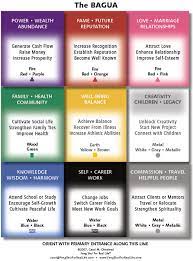
One of the doctrines of feng shui is that your home can be divided into nine zones, each of which signify some area of your life. If there is dirt or obstructions or things with the wrong color in a zone, it will bleed into the area of life it governs and cause problems.
There are a wide variety of solutions, ranging from decluttering, redecorating, cleaning, and sometimes installing a curative object like a statue or a crystal. If you fix your space, you can fix your life.
The nine zones are oriented to the entrance, so that the zone immediately to the left of the front door represents knowledge, and the middle rear represents fame and reputation. It’s all the same for every home.
The problem was that the book wasn’t quite sure where the entrance was supposed to be if you had an apartment that was in a larger building. Did you orient things based on your apartment’s entrance or that of the entire building?
It seemed as though the author never fully considered that these would be in disagreement with one another; and my initial searches on the Internet provided no resolution to the conflict. (The Web was a lot smaller and harder to search through back then.)
As it happened I was living in an apartment where the entrance was to the East but in a building whose front door was to the South.
After ruminating on the issue for a while, I decided to use the apartment entrance to orient the ninefold subdivisions. One reason why I may have chosen the apartment door, other than it seemed logical, was that the area which governed love and romance was especially cluttered, dark and dirty — and that might explain why I was forlornly single.
After reading that book, I spent a whole day cleaning up that corner. I took everything out which could be placed elsewhere. I swept and then scrubbed the floor with rose water. I put down a floor lamp and screwed in a red party bulb. I took a vase and filled it with silk red roses and sprayed some perfume on it as well.
For science!
Now, the rest of the apartment looked like a war zone; but hey, at least that one corner looked and smelled gorgeous.
The very next day, I got a phone call from a woman DJ I slightly knew. She lived in the Midwest but found herself unexpectedly in NYC and needed to tell me something in person. Could she come over? Sure. It was a surprise but I was curious to see what was so urgent.
I’m not sure how that conversation began, but it very quickly turned amorous. Clothes were discarded. She had a lot of tattoos and piercings. I had the absolute best sex of my entire life with her. She left afterwards, seemingly very pleased; and then she fell out of touch forever.
Needless to say, I was very very impressed with feng shui and wanted to implement the principles of it in every area of my life. I was thrilled. Was I the first person to figure this out? Feng shui was my new favorite thing!
But another shoe was to drop.
Some time later, new articles on feng shui were posted on the Web which firmly resolved the whole entrance enigma. The correct way to determine the zone of love was definitely to use the entrance of the entire building; not the apartment entrance as I had used.
I had redecorated the area which influenced one’s money, and it was compatible with purple rather than red. It shouldn’t have done anything. It’s not as if decluttering and cleaning was bad, but it shouldn’t have influenced my love life.
And yet, something definitely had happened. I mean, within a day some hot acquaintance came to my home from out of town, screwed my brains out and then went away happily. That couldn’t have been a coincidence. And I’m pretty sure it wasn’t. The rapidity was highly impressive. But I was very confused for a bit.
The thing is, I was using the wrong part of my apartment— but I didn’t know that. I believed I was summoning love into my life, and so it manifested. The symbols and correspondences had no inherent value. They had the value I had defined arbitrarily. And that’s not feng shui at all. That’s a different kind of magic; but magic it is.
Magic is not a unitary thing, and one of the big distinctions is where the power is drawn from. Most Victorian and post-Victorian magics draw their power from intentionality and visualization, and when you use that as a power source it has rules and limitations distinct from magics which tap into different fuels.
One of the patterns I observe is that Victorian magic influences the mind far better than material reality, seldom breaks natural laws, and even when fed power constantly tends to have a short life span.
That’s why in retrospect I’m not surprised that my DJ friend developed a sudden compulsion to have sex with me and then exited the story forever. It was my visualization and expectation which fueled the magic, not the flow of energy through a space or any established correspondences. That might have produced a very different result.
When we operate using traditional astrological magic, we are not largely drawing our power from intentionality. We are drawing power from spirits of time and forces very much outside ourselves, and the limits of the self as a conduit don’t apply to it nearly as much. Which is why one of the traits of astrological talismans is durability; they cast influences for decades without interruption, and those influences themselves tend to be permanent or long-lasting.
You can engage in a mystical or magical practice and incorrectly interpret what is actually going on, even if you get a little of what you wanted. The result will inevitably be frustration, because it will be impossible to change the limitations of the chameleonic system. It is easy to get lost in the dark forest; stick to the well-trodden paths.
When you operate outside the established correspondences and rules, anything can happen. One of them is having a completely different system of metaphysics kick in and produce surprises– though usually it’s a bad surprise.
This is part of why it’s useful to have a frame of reference in several different systems of magic, and a deeper understanding of how they operate. Because then a practitioner will have a chance at recognizing the traits of a system which is masquerading as another, using different sources of power, and operating by entirely different rules.
A lot of astrological magic out there today is something which looks like the Science of Images but doesn’t work like it at all. And we should be on guard against this confusion.
Accept no substitutes.

 The Astrological Magic™ Blog